

How SEO Changed in 2026: The Google Shift Every Business Needs to Understand
Google's AI answers now sit above the blue links. Here is what that means for your business.
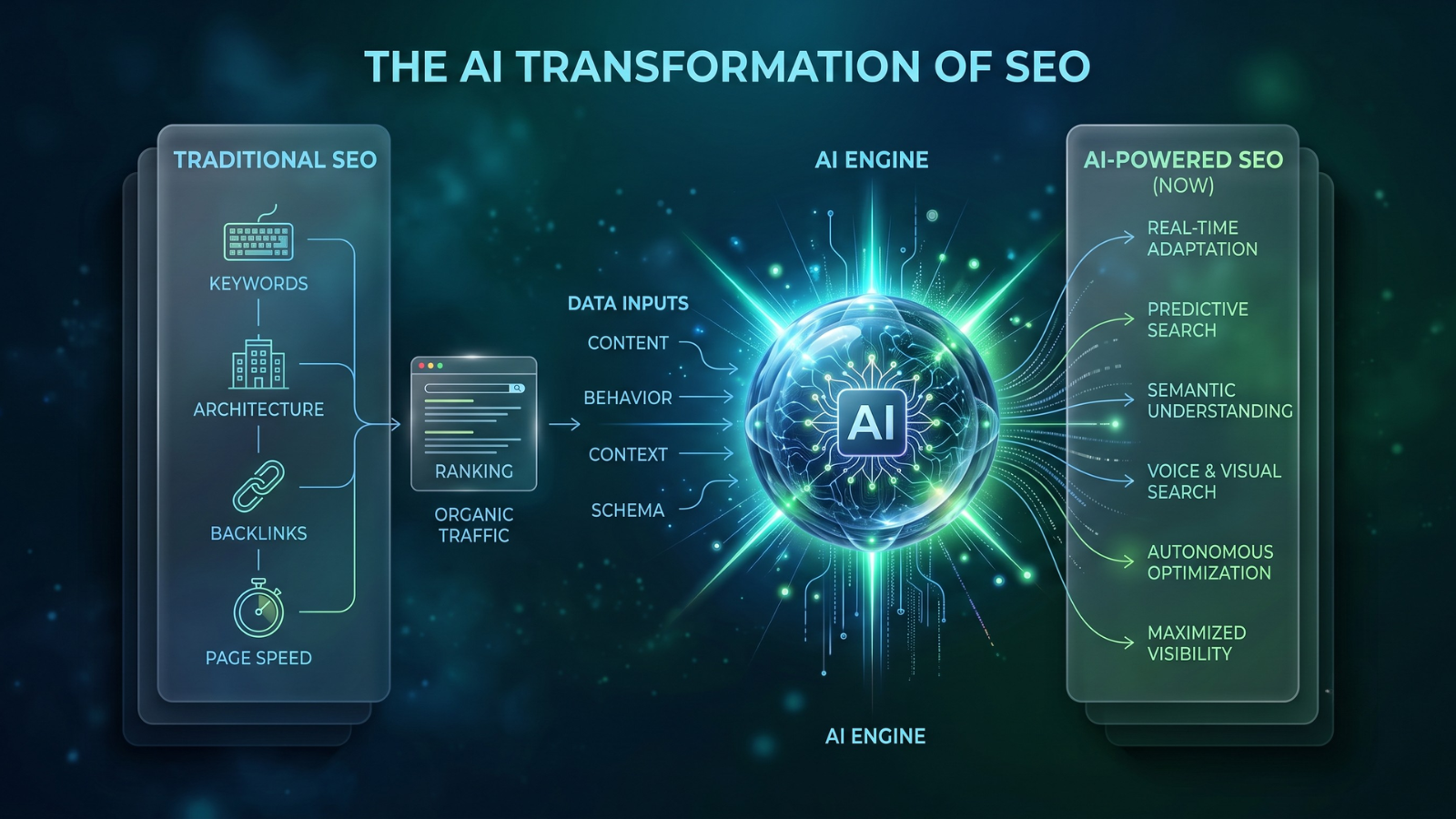
If your Google rankings held steady this year but your traffic quietly slid, you are not imagining it. Something structural has happened to search in 2026, and the cause sits at the top of almost every results page: AI.
Search engine optimisation has not died. It has changed shape. The old goal of ranking on page one is no longer the finish line. The new goal is being named inside the answer Google generates before anyone scrolls. Here is what changed this year, what Google itself has said about it, and what it means for your business.
The headline shift: from ranking to being cited
For two decades, SEO success meant one thing. You ranked, people clicked, they landed on your site. In 2026 that chain broke for a large share of searches.
Google's AI Overviews, the AI generated summaries that sit above the traditional blue links, now serve more than two billion monthly users, and the standalone AI Mode crossed one billion monthly active users in its first year, roughly ten times growth in twelve months. Google's own CEO Sundar Pichai called AI Mode the biggest upgrade to Search the company has ever made.
The consequence is simple to state and uncomfortable to absorb. You can rank first and still be left out of the AI answer, and the AI answer is increasingly what the user reads. Being ranked and being cited are now two separate outcomes, and citation is the one that drives visits.
What the data actually shows
The numbers behind this shift come from large, independent studies rather than guesswork.
On click-through rates, Pew Research analysed roughly 68,000 real queries and found the click rate roughly halved when an AI Overview was present, dropping from about 15% to about 8%. Ahrefs measured a 34.5% drop in click-through rate for the number one organic position across 300,000 keywords. Amsive found a smaller but still meaningful average decline of around 15% across 700,000 keywords. The range is wide because the impact depends heavily on query type.
Informational queries, the how-to and definition searches, are hit hardest. Commercial and transactional queries, where people want to compare, buy, or hire, are far more protected because users still click through to complete a decision. That distinction matters enormously for how you prioritise your content.
There is a second, more hopeful side to the data. Brands cited inside an AI Overview earn roughly 35% more organic clicks than competitors who are not cited on the same results page, according to Seer Interactive. AI search is not uniformly suppressing clicks. It is redistributing them toward the sources it trusts and names.
Ranking first no longer guarantees inclusion
Here is the change that surprised even experienced practitioners. In mid-2025, the sources cited inside an AI Overview overlapped heavily with the top ten organic results, by roughly three quarters. By early 2026, that overlap had fallen to somewhere between 17% and 54% depending on the study.
In plain terms, Google is drawing its AI answers from a much wider pool than the visible top ten. A single overview now pulls from an average of around thirteen sources, up from roughly seven in 2024. Your page can be cited without ranking on page one, and it can rank on page one without ever being cited. Community and video platforms have benefited most from this widening, with Reddit and YouTube appearing frequently as cited sources.
Google I/O 2026 formalised the new model
At Google I/O in May 2026, three announcements reset the brief for anyone doing SEO.
- First, Google redesigned its search box, described as the biggest upgrade to the box in more than 25 years. It now accepts longer, conversational input along with images, files, video, and even Chrome tabs, and it is built to anticipate intent rather than match keywords.
- Second, AI Mode moved from experiment to mainstream. Unlike AI Overviews, which still show blue links underneath, AI Mode often replaces the traditional results page entirely with a conversational answer. Under the hood it uses a technique called query fan-out, breaking a single question into dozens of smaller sub-searches and synthesising the results into one response. A well written, genuinely thorough page can surface for related questions it was never explicitly written to target.
- Third, Google introduced agentic features, including AI agents that can carry out tasks such as booking appointments on a user's behalf. For local and service businesses, this means an AI agent may soon be the first thing that contacts your front desk.
Google's verdict on AEO and GEO: it is still SEO
For most of the past two years, a cottage industry sold "Answer Engine Optimisation" and "Generative Engine Optimisation" as brand new disciplines requiring new files, new formats, and new retainers. On 15 May 2026, Google published its first official guide on the subject and settled the debate directly.
The guide, "Optimising your website for generative AI features on Google Search," makes Google's position blunt: "optimizing for generative AI search is optimizing for the search experience, and thus still SEO." AI Overviews and AI Mode run on the same core index, ranking, and quality systems as classic Search. There is no separate AI index to buy your way onto.
Just as useful is the mythbusting section, where Google names popular tactics and tells site owners to ignore them for Google Search:
- llms.txt files and special markup. You do not need to create machine readable AI files. Google may crawl them, but they get no special treatment.
- Content chunking. There is no need to break content into tiny fragments for AI. Google's systems understand multiple topics on a single page, and there is no ideal page length.
- AI-specific rewriting. Rewriting to capture every long-tail variant is unnecessary, because the systems understand synonyms and meaning.
- Special schema or Markdown versions of pages. Not required for inclusion in AI features.
Google also quietly confirmed that its spam policies now explicitly apply to AI responses, so trying to game your way into AI answers carries the same risk as gaming traditional rankings.
The takeaway is reassuring for anyone who has done the fundamentals properly. The work that earns a ranking is the work that earns a citation. What changed is the surface, not the discipline.
The 2026 core updates: what Google is rewarding
Two broad core updates landed this year and both drove heavy volatility. The March 2026 core update ran from 27 March to 8 April and was the most volatile update on record at the time, with nearly 80% of top-three results shifting position and about one in four top-ten pages falling out of the top 100 entirely, according to SE Ranking data shared with Search Engine Land. The May 2026 core update followed from 21 May to 2 June and, by several analysts' accounts, hit even harder.
The direction of travel is consistent across both. Visibility moved away from intermediaries, aggregators, and thin affiliate sites, and toward strong destinations, recognisable brands, owned data, and content that demonstrates genuine first-hand expertise. Affiliate sites without proprietary content were among the hardest hit. Publishers with clear expert authorship and original research tended to hold ground or gain. Google is rewarding sources that add knowledge to the web rather than repackaging what already exists.
Practical changes worth acting on now
Beyond the big shifts, several concrete changes affect day-to-day SEO work in 2026:
- FAQ rich results were removed. From 7 May 2026, Google stopped displaying the expandable FAQ enhancement in search results. Importantly, the FAQPage structured data type itself is not deprecated. Structured data still helps AI systems read and represent your content accurately, so keep it. The visual SERP feature is what went away.
- Search Console now reports AI visibility. New performance reports show impressions inside AI Overviews and AI Mode. Watch impressions alongside clicks. Rising impressions with flat clicks often signals AI Overview presence rather than a content failure.
- Preferred Sources expanded into AI Overviews. Users can now choose websites they want to see more of, including inside AI answers. It does not directly change rankings, but it does make your loyal audience a genuine visibility signal. Prompt your newsletter subscribers and repeat readers to add you.
- Quality signals are behavioural. In a May 2026 interview, Pichai confirmed Google calibrates AI search using long-term user satisfaction signals such as engagement, session behaviour, return visits, and bounce-backs, measured at scale rather than per site.
What this means for South African businesses
AI Mode and AI Overviews rolled out across roughly 200 countries this year, so this is not a distant American problem. Local businesses feel it too, and the response is not exotic.
Focus your effort on topical depth rather than keyword count. Build a small number of thorough pages that fully answer one question each, rather than many shallow ones. Lead with the answer, keep structure clean, and support claims with data, examples, and clear authorship. Invest in the signals that travel beyond your own domain, such as genuine mentions, reviews, and a recognisable brand, because Google increasingly leans on recognised entities when it decides who to cite. Track citation presence, not just rank position, and treat impressions inside AI features as a real metric.
For transactional and commercial pages, the picture is steadier. People still click when they are ready to buy or hire, so protect and sharpen those pages and the conversion paths behind them.
The bottom line
SEO in 2026 did not end. It split into two surfaces: the traditional ranking you have always chased, and the AI answer layer that now sits above it. Google has told us plainly that the same fundamentals feed both. Non-commodity content, clean technical foundations, real expertise, and a recognisable brand are what earn a citation and a ranking alike.
The businesses winning this year are not chasing hacks. They are doing the real work, measuring where it lands across both surfaces, and keeping it current. That is a strategy any serious business can execute, and it is exactly the work worth committing to now.
References
Pew Research Center, on click rates with and without AI Overviews across 68,000 queries, cited via Stackmatix: https://www.stackmatix.com/blog/google-ai-overview-seo-impact
Ahrefs and Amsive click-through rate studies, summarised: https://www.stackmatix.com/blog/google-ai-overview-seo-impact
Seer Interactive, on the citation click premium, and I/O 2026 recap: https://www.digitalapplied.com/blog/seo-after-google-io-2026-90-day-playbook
Google AI Overviews statistics and citation source data: https://quickseo.ai/blog/google-ai-overviews-statistics-2026-60-data-points-every-seo-should-know
Google I/O 2026 AI search update and AI Mode figures: https://launchcodex.com/blog/seo-geo-ai/google-io-ai-search-seo-update/
Google Search Central, official guide to optimising for generative AI features: https://developers.google.com/search/docs/fundamentals/ai-optimization-guide
Google Search Central Blog announcement of the guide (15 May 2026): https://developers.google.com/search/blog/2026/05/a-new-resource-for-optimizing
Search Engine Journal, on Google calling AEO and GEO still SEO: https://www.searchenginejournal.com/googles-new-ai-search-guide-calls-aeo-and-geo-still-seo/575026/
Search Engine Land, on the March 2026 core update volatility data: https://searchengineland.com/march-2026-google-core-update-what-changed-474397
Search Engine Land, March 2026 core update rollout complete: https://searchengineland.com/google-march-2026-core-update-rollout-is-now-complete-473883
Search Engine Land, May 2026 core update rollout complete: https://searchengineland.com/google-may-2026-core-update-rollout-is-now-complete-479119
FAQ rich results removal, Preferred Sources, and Search Console AI reporting: https://upwardengine.com/blog/what-googles-may-2026-ai-search-announcements-mean-for-your-business/
Google Search changes 2026, including core update direction and Pichai quality-signal comments: https://www.yellowhead.com/blog/google-search-changes-2026/
AI Mode query fan-out and AI Overview prevalence context:
https://www.itorixinfotech.com/ai-seo-in-2026-how-googles-ai-overviews-are-changing-rankings-and-how-to-win/